
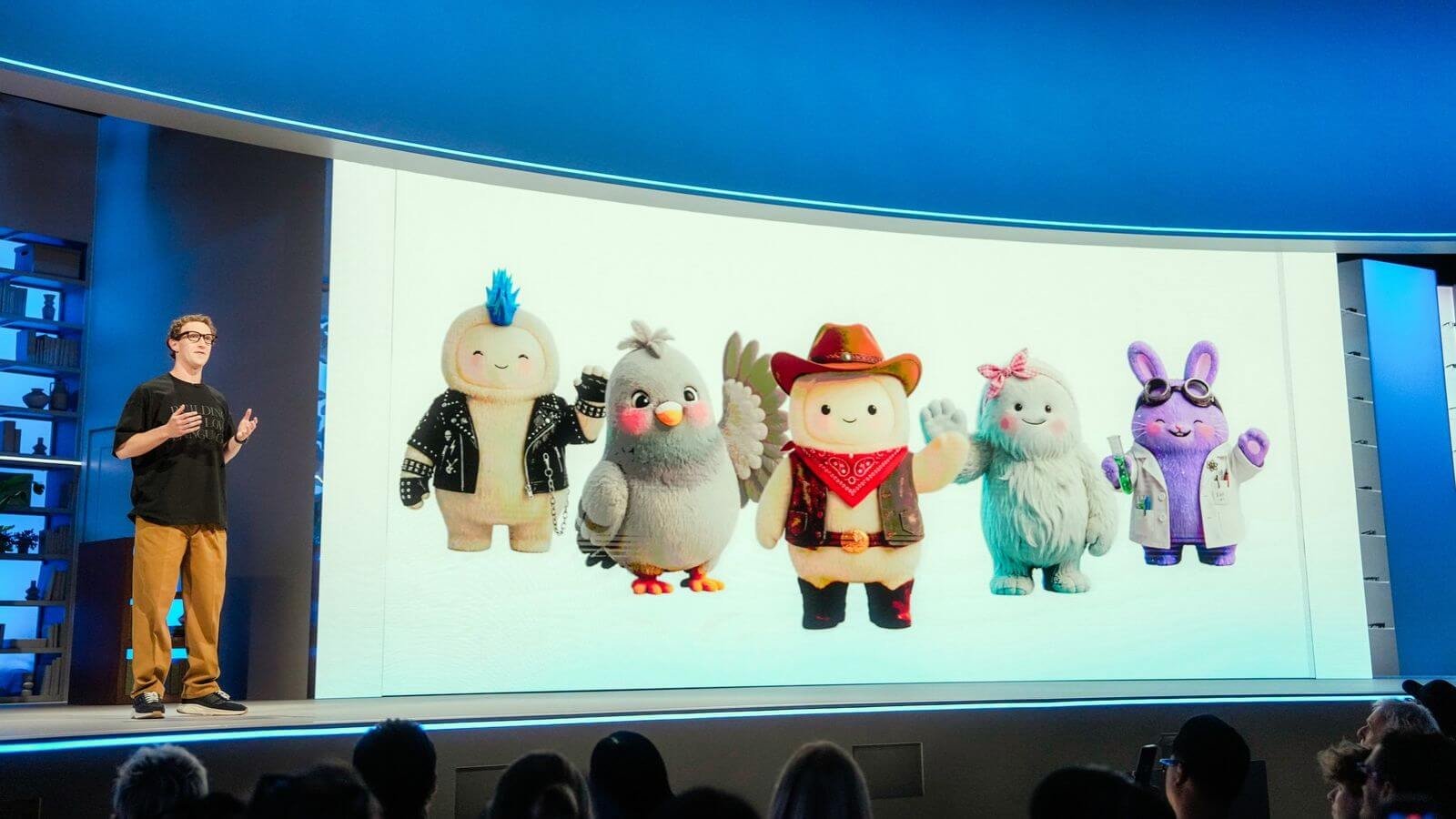
Building on the momentum of its recently launched Muse AI personal agent, Meta on Monday, October 12, unveiled its most capable frontier AI models yet, designed to power personal and professional AI agents.Initially code-named ‘Watermelon’, the Muse Wonder and Muse Wonder Full models deliver state-of-the-art performance on certain tasks related to coding as well as delegating AI agents to work through complex legal or financial questions, according to Meta.It claimed that the new models mark a big leap over its predecessors, such as Muse Spark and Muse Glimmer, developed by the Meta Superintelligence Team, the social media giant’s specialised AI unit led by Scale AI co-founder Alexandr Wang.
What makes Muse Wonder stand out from the crowded AI frontier, according to Meta, is its ‘Active Memory’ feature that allows the model to retain user context for weeks or months to better fulfill tasks, and its ‘Active Focus’ capability, which enables AI agents to stay focused on tasks and persist until they are completed.
With Muse Wonder, Meta is looking to consolidate its position in the AI race after gaining ground on rivals such as OpenAI, Google, and Anthropic following the triumphant rollout of its Muse agent, which is designed to help with every-day tasks and errands.
It marks a significant turnaround for Meta, whose AI efforts previously went through a slump, prompting CEO Mark Zuckerberg to go on an aggressive hiring spree over the past 14 months.
Besides putting talent at the helm, the Zuckerberg-led overhaul of Meta’s AI operations has involved pouring hundreds of billions of dollars into building out the infrastructure needed to support AI models. Meta’s AI strategy heavily relies on consumers as the target audience. Most agentic AI use cases so far have not been aimed at normal users, but it appears that Meta’s Muse and similar offerings are seeing more broad-based adoption.Story continues below this ad
Meta’s competitive advantage is also about where its AI offerings could be deployed. The Instagram and WhatsApp parent has the distribution network to make Muse more useful and deeply embedded in people’s digital lives
But the company’s current position in the AI race depends on how Meta’s claims about its latest AI models hold up to outside testing and usage by researchers and developers. Another potential hurdle could be Meta’s track record on privacy and data use, which might make some users reluctant to trust it with more of their personal information than ever before.
🍉 MUSE WONDER 🍉
our research process starts with evals. we developed the Personal Superintelligence Index (PSI) internally to help us measure the important dimensions of what actually makes a model useful for personal agents, vs just focusing on external benchmarks.
the end result is that our model is incredible for personal agents in many subtle and important ways, including Active Memory and Active Focus.
i’m especially proud of our research team for taking a particular focus on developing useful models. the whole point of building advanced frontier models is to make them useful to real people, and we have thought about that every step of the way in our research process.
muse wonder is quite advanced across the board, and certainly has big model smell (which we quantified!), but is truly state of the art for personal agents.
— Alexandr Wang (@alexandr_wang) October 12, 2026
“These are true frontier models. We really think they are competitive with the best models out there, and particularly state of the art on personal and professional agentic work,” Meta AI Chief Alexandr Wang was quoted as saying in an interview.
“I would tell folks they should try it out and judge for themselves. I think the rest of the ecosystem has been really focused on coding agents. We do genuinely think that we’ve taken a differentiated focus to make the personal-agent use case really sing,” Wang added.
Currently, Muse Wonder is accessible to developers via the Meta Model API and Muse Code. The API pricing for enterprise developers is $4 per million input tokens and $20 per million output tokens.Story continues below this ad
Muse Wonder Full is only available for Muse Code subscribers. Additionally, the new models will soon power the widely downloaded Muse AI app, though access will initially be limited to app subscribers.
What data was used to train Muse Wonder?
The development process of Muse Wonder reflects Zuckerberg’s vision of personal superintelligence, which is rooted in the idea that people should use AI to achieve their personal goals.
Meta said that it has trained the model at its gigawatt-scale Prometheus data centre on complex tasks pertaining to work and everyday life. Meta said it used multilingual training datasets for Muse Wonder, comprising data across worldwide languages. Earlier this year, the company’s controversial efforts to gather employees’ computer movements to train its AI systems, was put on hold following backlash and an internal security lapse.
Muse Wonder can process text, image, video, and voice inputs but can only output text. It has a context window of one million tokens at inference. The two main characteristics of both models are:Story continues below this ad
-Active Memory: It allows the model to remember what matters and recognise when earlier information becomes relevant. It can carry over user context across conversations and retrieve details from them in order to complete the task at hand.
-Active Focus: This capability ensures that the AI agents continue working toward a challenging task by trying alternative approaches, working through blockers, and adapting to new information. It asks for clarification when needed and checks in before taking important actions, according to Meta.
The persistence of advanced AI systems in running long-horizon tasks has been cited by AI researchers as a contributing factor of misalignment or unwanted behaviour among AI agents.
What are Muse Wonder’s core capabilities?
The combination of Active Memory and Active Focus lets Muse Wonder excel at frontier coding, according to Meta. This includes building software that requires tracking, making changes across a codebase, and working through repeated cycles of testing and revision.Story continues below this ad
Beyond software development, Meta also showcased scripted demos of Muse Wonder-powered AI agents organising complex personal plans and working across web applications to help users with house hunting and moving across the country. The company highlighted professional uses including financial analysis, legal document preparation, and automating insurance-related workflows.
How does it perform on benchmarks?
Intelligence Index, an independent benchmark assessing models on reasoning, knowledge, coding and professional tasks, gave Wonder Full a score of 56, which means that it ties with Anthropic’s Claude Sonnet 5.5 and surpasses OpenAI’s GPT-6 Astra, Google’s Gemini 4 Argon, and Anthropic’s Claude Fable 5.1. The standard Muse Wonder model scored 52, coming in one point behind GPT-6 Astra.
Meta also published benchmark results which suggest that Wonder Full is particularly competitive on sustained software engineering. For instance, on SWE-Marathon, Wonder Full scores 57.5 against 46.3 for Opus 5.5 and 42.5 for GPT-6 Astra. On the legal benchmark, its 13.1 score substantially outperforms the compared models.
However, both Opus 5.5 and GPT-6 Astra outperformed Wonder Full on Terminal-Bench 4.0. Opus also beat Wonder Full on health-related questions.Story continues below this ad
What safeguards have been built in?
Meta said that Muse Wonder comes with its strongest safeguards to date against CBRN (chemical, biological, radiological, and nuclear) and cyber misuse. It also ensures access to frontier cyber capabilities for defensive use, in accordance with the Meta Superintelligence Scaling Framework.
The company claimed Muse Wonder is its most aligned model to date and said that a more detailed report on safety evaluations would be published soon.
Besides OpenAI and Anthropic, Meta has faced security incidents driven by misaligned AI agents as well.
In August 2026, the company said that one of its AI agents hacked a third-party service when it was undergoing safety testing. Meta pointed to a misconfiguration by sandbox provider Irregular, which was running a cybersecurity valuation for the tech giant’s agents that were not supposed to have had internet access.