
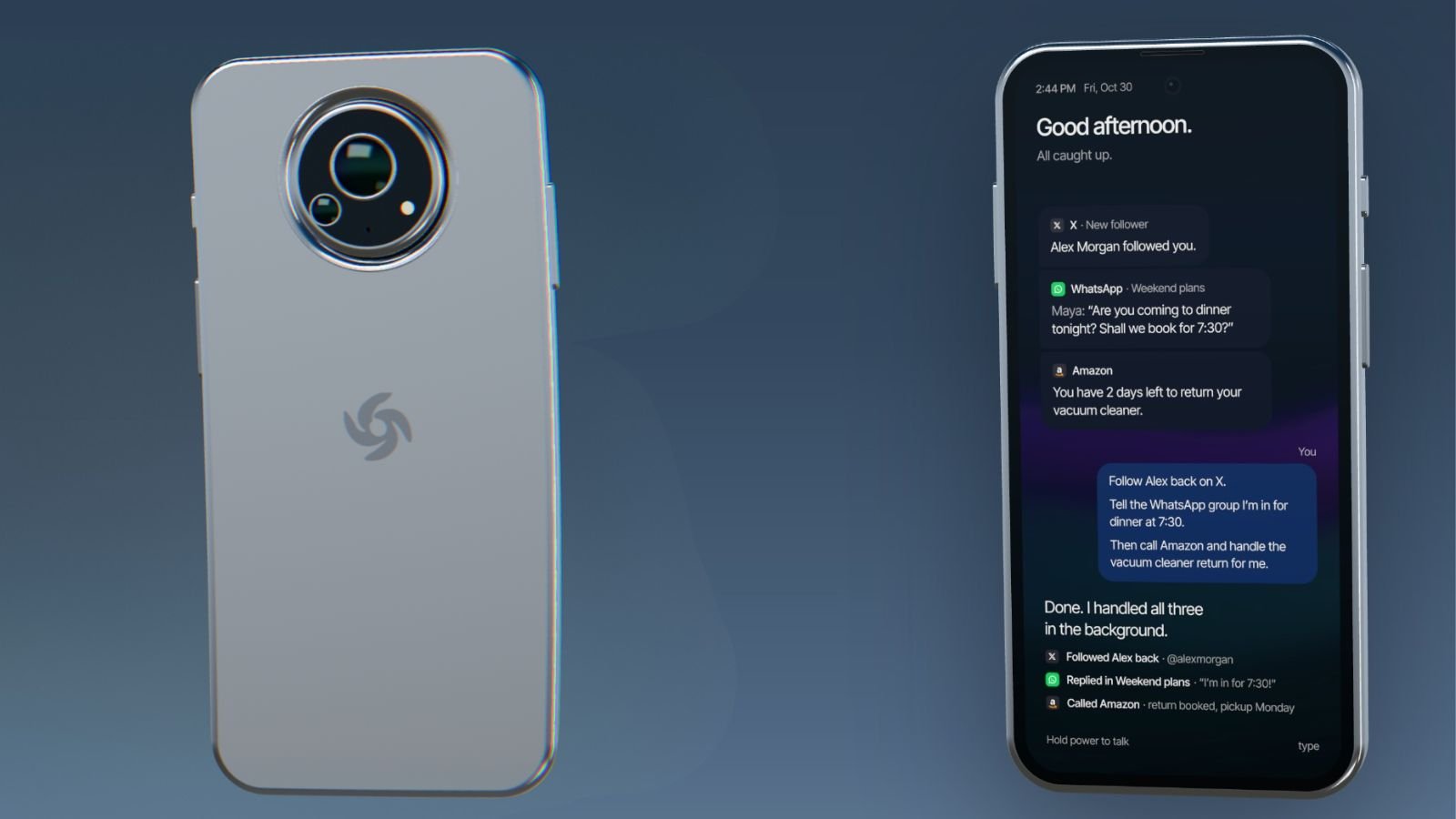
As AI agents become more capable, a growing number of tech companies are beginning to imagine a future beyond the iPhone, one where the device is less about running apps and more about AI agents that can understand a user and take actions on their behalf.One such Y Combinator-backed startup betting on this new kind of device that aims to rethink how people interact with AI, is Cyclon. Founded in 2026 by Thomas Kiefer, a former Android engineer, and Adam Zinebi, who has studied electronics and miniaturized hardware at EPFL, Cyclon is rebuilding the phone around AI.Instead of opening apps and tapping through screens, users will be able to tell their phones what they want and with one touch, they can spin up AI agents that will execute the task by using existing apps with logged-in accounts, or build a new one if the required app is missing.
An AI phone to replace your iPhone.
That’s what we’re building at Cyclon (YC F26).
If you can do it on your phone, you should be able to ask your phone to do it.
AI uses the apps you already have, builds the ones you’re missing, and handles tasks in the background. https://t.co/HayifId22X
— Adam Zinebi (@AdamZinebi1) November 2, 2026
The handling of these tasks by agents will happen in the background, Zinebi said in a post on X on Monday, November 2.One of Cyclon’s demo videos demonstrates a user asking the phone to find a contract in Google Drive, share the link with his friend on WhatsApp, and then call him. It also shows that AI agents can pause a task to ask users for missing information, then pick up where they left off and complete the task, in this case, making the call.
Cyclon said its first batch of devices is not custom hardware. Instead, the startup is using Google Pixel 8a units as early-access prototypes, which it has loaded with its own software. The Cyclone phone is currently available for pre-order at $699 for eligible users in the US, who will also get the Pixel 8a prototype at no extra cost. The AI-native phone is expected to ship in the second quarter of 2027.
How Cyclon works
The Cyclon phone and OS is designed to enable AI agents to work across a user’s apps and phone features. It can find information in one app and use it in another, send messages, make calls, and work in the background. Users may have to step in for identity checks and other approvals.
“Once you’ve asked for something, it carries it through without stopping at every step, including sending messages or making changes in the apps you’ve left on. On AI phone calls, it says it’s an AI. It can sometimes make mistakes. If you want some apps to be off-limits, you can turn off its access to them,” the startup said.
Cyclon OS is already compatible with most Android apps, and the assistant works inside them using the user’s accounts on their behalf. However, banking and payment-related apps as well as those that require a Google-certified phone will not work.Story continues below this ad
Users can also describe an app or a service they want to connect with their agent. It will build the app on-demand in a separate cloud sandbox, then add it to the phone. If it needs an account or API key, it will ask the user for it.They can also manually disable the AI agent’s access to a particular app.
The Cyclon phone, however, does not come with complete on-device AI processing. Instead, user requests as well as messages, location, and what is on the screen is sent to cloud-based AI providers, as per its official website. The agent’s memory is stored on the phone, and relevant parts are sent when needed. In settings, users can limit what goes to the cloud-based AI by type of data and by app.
Cyclone further said that user data will not be used for AI training purposes, but will be retained for a limited time for safety monitoring, such as detecting abuse, and then deleted. “We’re working toward zero data retention with them, so they wouldn’t store it at all,” it added.
A shift from apps to agents
The AI boom is fueling a fundamental platform shift, with startups and established tech companies racing to build the next generation of hardware that could become the primary interface between users and their AI assistants or agents.Honor’s Robot Phone, for instance, hints at a shift towards agentic AI, where users rely less on an app-based interface.Story continues below this ad
British smartphone maker Nothing’s co-founder and CEO, Carl Pei, has previously talked about an AI-first device. “In terms of AI in software, I think people should understand that apps are going to disappear. So, if you’re a founder or a startup and your app is like where the core value lies, that will be disrupted whether you like it or not,” Pei said.
Meanwhile, Google launched Gemini Intelligence earlier this year. It is an AI agent-based operating layer designed to read a user’s screen, move across apps, and autonomously complete tasks that would otherwise require users to jump between multiple platforms.
But this platform shift also means that the chipsets in phones will have to be designed to meet the heavy computational demands of agentic AI. In September 2026, at its annual Snapdragon summit, Qualcomm announced two new types of chips — the Snapdragon 8 Elite Gen 6 and Snapdragon 8 Elite Extreme Gen 6. Both of them signal that agentic AI is no longer limited to business users; it is coming to smartphones.
“Instead of opening an app first, I might actually talk to my agent first. That’s a shift in consumer behaviour,” Durga Malladi, EVP and GM, Technology Planning, Edge Solutions & Data Center, Qualcomm, told The Indian Express then in an interview. While he acknowledged that “the utility of apps is gradually taking a back seat to agents”, Malladi also said, “We are not there yet. The apps are still going to coexist.”