
Former Twitter CEO Jack Dorsey has introduced a new speech model named Dessa from his company Block. Announcing the development, Dorsey said in his X post that Voice is the most natural way to interact with intelligence and Dessa is the most authentic full-duplex speech model.The speech model is compact and can be run on a laptop. “This is big (but also really, really small…small enough to run on your MacBook). “I’m extremely proud of the Dessa team for pushing the frontier!” Dorsey wrote in his post describing the flexibility of the model. The company claims that inference runs faster than real time, and there is no latency. It runs locally on a MacBook Pro M4 Max or better.
Dessa is claimed to be trained from scratch on real human conversations. There is no text and no pretrained models involved. The most remarkable thing about Dessa, according to the company, is that it listens and talks at the same time, meaning audio in and audio out, with no transcription layer in between. As of now, it is in research preview behind a waitlist without a parameter count, API, price, weights, or published evaluation. So far, the only evidence of its capabilities is the demos that are in the public domain.
We believe voice is the most natural way to interact with intelligence, so we created Dessa, the most authentic full-duplex speech model ever built. Talking with it feels like talking with a person…full of emotion, nuance, pauses, and a natural cadence.
https://t.co/r0qFLdvd6c
— jack (@jack) October 23, 2026
At present, voice AI comes with some limitations, as it simply turns voice into text and overlooks a large amount of information that cannot be contained in text. The official website of Dessa claims that most powerful AI models in the world cannot hear how a user feels. And this, according to the company, leads to a worse experience and is potentially dangerous.
The company claims that it trained Dessa with only sounds and no text or pretrained models. “It learned to hold a real-time conversation simply by listening. As far as we know, Dessa is the world’s first AI you can have a realistic live conversation with that was trained only from human speech,” reads the website.
According to the company, Dessa is essentially an advancement in deep learning models, offering new avenues for researchers to discover. It raises crucial questions: how efficiently it learns language and facts compared to text? How efficiently can it learn new languages? What sorts of in-context learning can they perform?
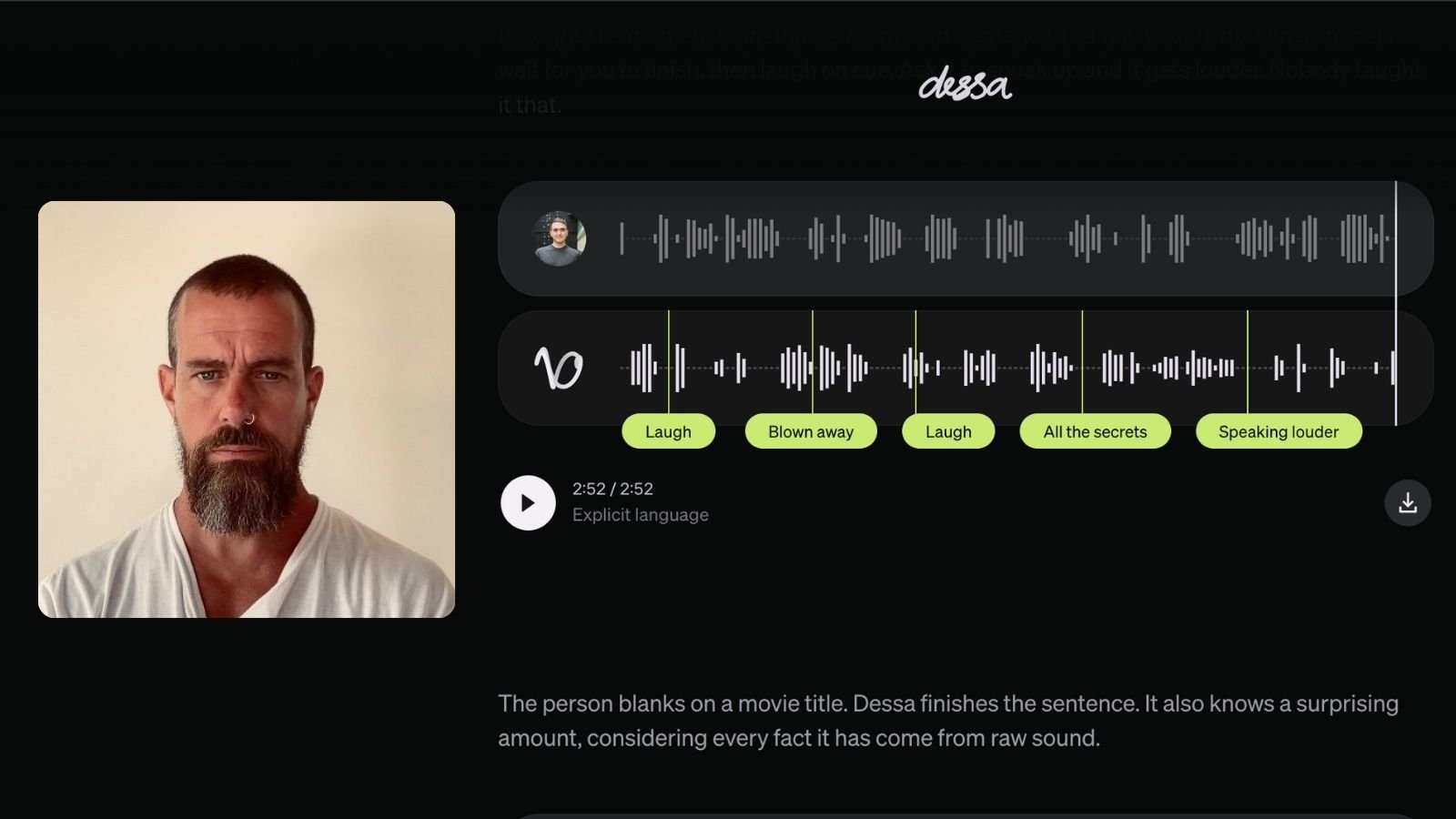
The website also features a live recording of a person talking to Dessa. The speech model is not managed by anyone, yet it autonomously picks what to say, when to say it and how, with its own distinct voice and personality. The recording shows Dessa laughing casually mid-sentence when something funny turns up. In contrast, other models wait for the user to finish and then laugh on cue. Dessa essentially fills in when a user blanks out mid-sentence; she gasps like a real person and sounds genuinely empathetic. The company also shared a demo of Dessa interacting with ChatGPT Live.
What makes Dessa different?
Large language models rely on massive amounts of text for training, while Dessa reportedly learned language from hundreds of words. Dessa had to learn much more than language; it had to study accents, pauses, breathing patterns, humour, sarcasm, inflection, emotion, and most importantly, when to stop. When it comes to speech, saying a sentence twice in the exact same way, yet the data comes out different. But when it comes to text, it is identical regardless of the author.Story continues below this ad
Also, a single spoken word consumes thousands of times more bytes than the same word in text. This shows the complexity of training a machine that has no text to learn from but just audio. The company claims that they cracked the code and found a way to train Dessa on only one NVIDIA GB200 NVL72.
Dessa is the creation of a small AI research lab at Block that was founded by former members of Dessa, a deep learning startup from Toronto. The researchers have been building deep learning models and generative speech models for years.